When Things Don’t Go Well
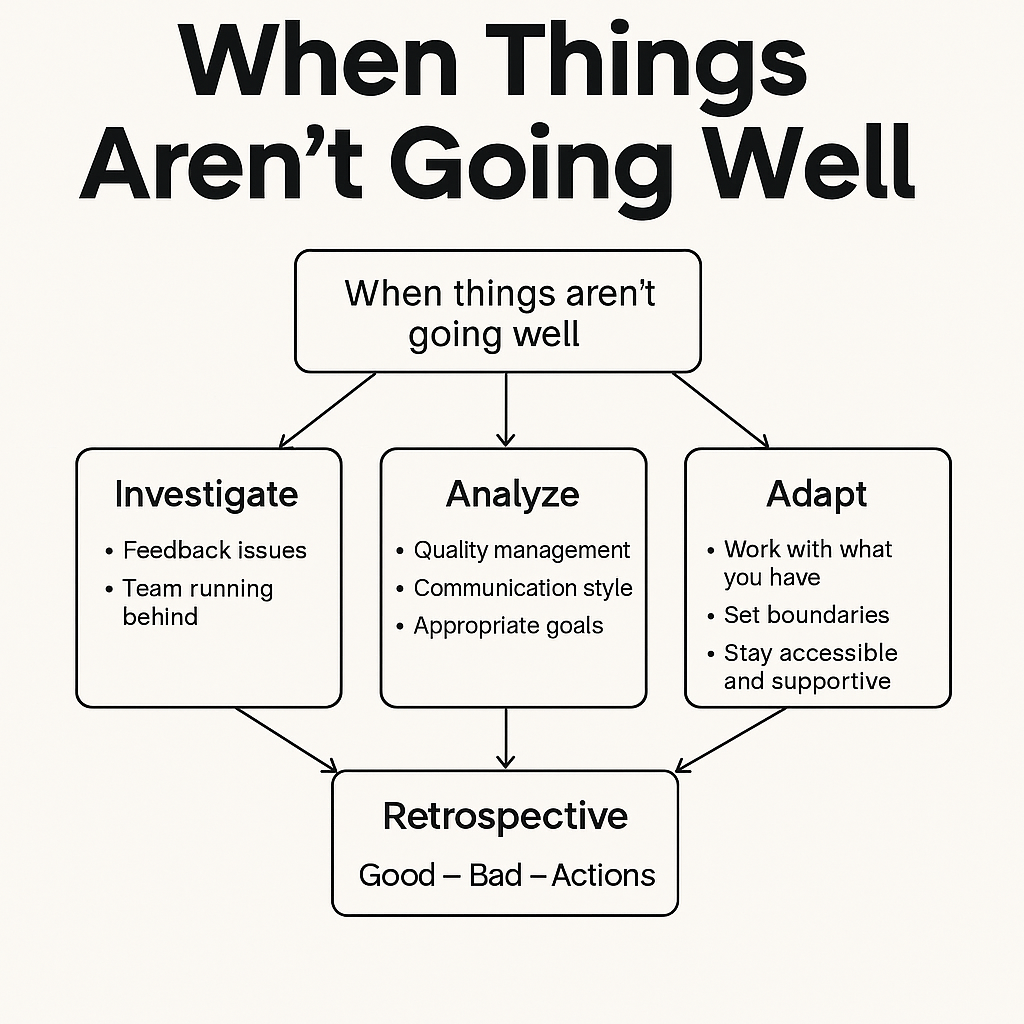
Every leader faces moments when things simply don’t go well. The signals are usually clear: feedback that points to frustration, retrospectives that repeat the same patterns, messy communication on the team chat, or tasks that keep slipping.
Looking for the real cause
When a team is just starting, slow progress is natural. Sometimes it’s not enough to simply assign tasks — there needs to be feedback and data to check whether we’re moving in the right direction. That’s where quality management comes in.
From my own experience, it often means that the leader invests the most time in gathering and analyzing data. And then comes communication. Not in a directive, top-down way, but through questions and explanations. Teaching people that everything can be broken down into smaller steps — and that every problem has a solution.
Self-reflection is part of it, too. Are the goals I set clear? Are they achievable? As leaders, we must work with what we have and adapt activities so that the team can handle them, while still growing along the way.
Boundaries are not a cage
I’ve seen situations where people wanted full freedom to decide on their own. And while autonomy is important, I also learned the power of boundaries.
Boundaries are not there to kill creativity. They exist to help people orient themselves, to create a safe workspace, and to ensure no one feels lost. The key is to set them in a way that protects the team, but still leaves enough space for initiative and growth.
Lessons learned
I’ll admit it: sometimes I complain when I don’t know what to do next. And that’s okay — leaders are human, too. But I’m learning to work with that feeling, to reflect instead of just vent, and to turn it into a chance to adapt.
So when things don’t go well, I remind myself: data helps, communication matters, boundaries protect, and reflection keeps me moving forward.